
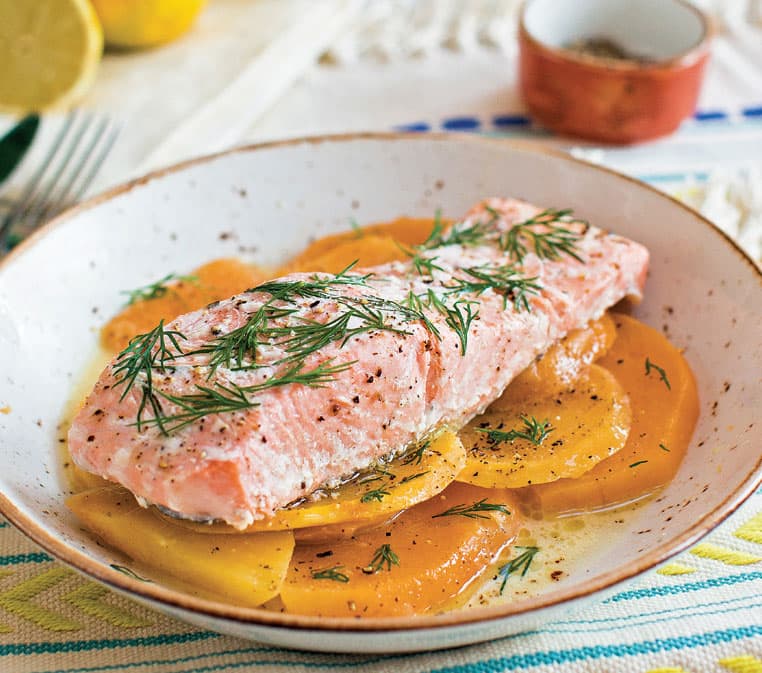
Craving a dinner that’s both elegant and effortless? Look no further. This Slow Cooker Salmon is a revelation, proving your trusty slow cooker isn’t just for roasts and stews. We gently poach delicate salmon fillets over a bed of tender rutabaga, infusing them with fresh dill, bright lemon, and a touch of luxurious cream. It’s a minimalist masterpiece that delivers maximum flavor with minimal fuss. Get ready for the most tender, fall-apart salmon you’ve ever made.
Ingredients
• MAKES: 4 servings
• PREPARATION TIME: 15 minutes
• COOKING TIME: 3 to 4 hours
• 3 tablespoons / 45 ml ghee or other healthy cooking fat, melted, divided
• 1 large rutabaga, about 500 g / 1.1 lb, peeled and cut into 1/4-inch / 1/2-cm slices
• 1/2 teaspoon fine sea salt, or to taste
• Ground black pepper, to taste
• 2 tablespoons / 30 ml water or fish stock
• 4 medium salmon fillets, about 150 g / 5.3 oz each
• 2 tablespoons / 8 g chopped fresh dill
• 2 tablespoons / 30 ml fresh lemon juice
• 1/4 cup / 60 ml heavy whipping cream or full-fat coconut milk
• 4 tablespoons / 60 ml extra-virgin olive oil, for serving
Instructions
1. Grease the slow cooker with 1 tablespoon / 15 ml of the ghee. Arrange half the rutabaga slices in a single layer, season with salt and pepper, and drizzle with another tablespoon of ghee.
2. Add the remaining rutabaga slices in a second layer, season with salt, drizzle with the last tablespoon of ghee, and add the water or fish stock.
3. Place 2 layers of paper towels or a clean tea towel over the top of the slow cooker bowl to absorb condensation, then secure the lid. Cook on low for 2 hours.
4. Place the salmon fillets on top of the cooked rutabaga. Season with salt and pepper, sprinkle with fresh dill, and drizzle with lemon juice.
5. Replace the paper towel and lid, and continue to cook on low for 1 to 2 hours, or until the salmon is cooked to your liking. Start checking for doneness after 1 hour.
6. Stir in the heavy whipping cream or coconut milk during the last 30 minutes of cooking.
7. To serve, place a salmon fillet and a portion of the rutabaga on each plate. Drizzle each serving with 1 tablespoon / 15 ml of extra-virgin olive oil. Store leftovers in an airtight container in the refrigerator for up to 3 days.
Nutritional Information
• Nutrition Per Serving
• Total Carbs: 11.8 g
• Fiber: 3 g
• Net Carbs: 8.8 g
• Protein: 34.2 g
• Fat: 39.6 g
• Energy: 544 kcal
• Macronutrient Ratio: Calories from carbs (7%), protein (26%), fat (67%)
Pro Tips
• To prevent a watery sauce, place a layer of paper towels or a clean tea towel over the ceramic insert before putting on the lid. This absorbs excess condensation.
• For a dairy-free option, substitute the heavy cream with an equal amount of full-fat canned coconut milk. It adds a lovely, subtle sweetness.
• Don’t overcook the salmon! Fish cooks quickly, even in a slow cooker. Check for doneness after 1 hour by flaking it with a fork. It should be opaque and separate easily.
• Ensure your rutabaga slices are uniform in thickness, about 1/4-inch (1/2-cm), so they cook evenly and become tender at the same rate.
FAQ
Q: How do I prevent my slow cooker salmon from being watery
A: To prevent a watery sauce, place a clean tea towel or a double layer of paper towels over the top of the slow cooker bowl before securing the lid. This simple trick absorbs excess condensation, ensuring a richer sauce.
Q: How do I know when the salmon is perfectly cooked
A: The salmon is done when it becomes opaque and flakes easily with a fork. Start checking for doneness after 1 hour of cooking on low to avoid overcooking, as it can cook very quickly even in a slow cooker.
Q: Can I make this recipe dairy-free
A: Yes, this recipe is easily made dairy-free. Simply substitute the heavy whipping cream with an equal amount of full-fat canned coconut milk. This also adds a lovely, subtle sweetness to the dish.
Q: What can I use instead of rutabaga
A: While rutabaga provides a unique, tender base, you could substitute it with other firm root vegetables like turnips or thinly sliced potatoes. Be aware that cooking times and nutritional values may change with substitutions.